Architecture
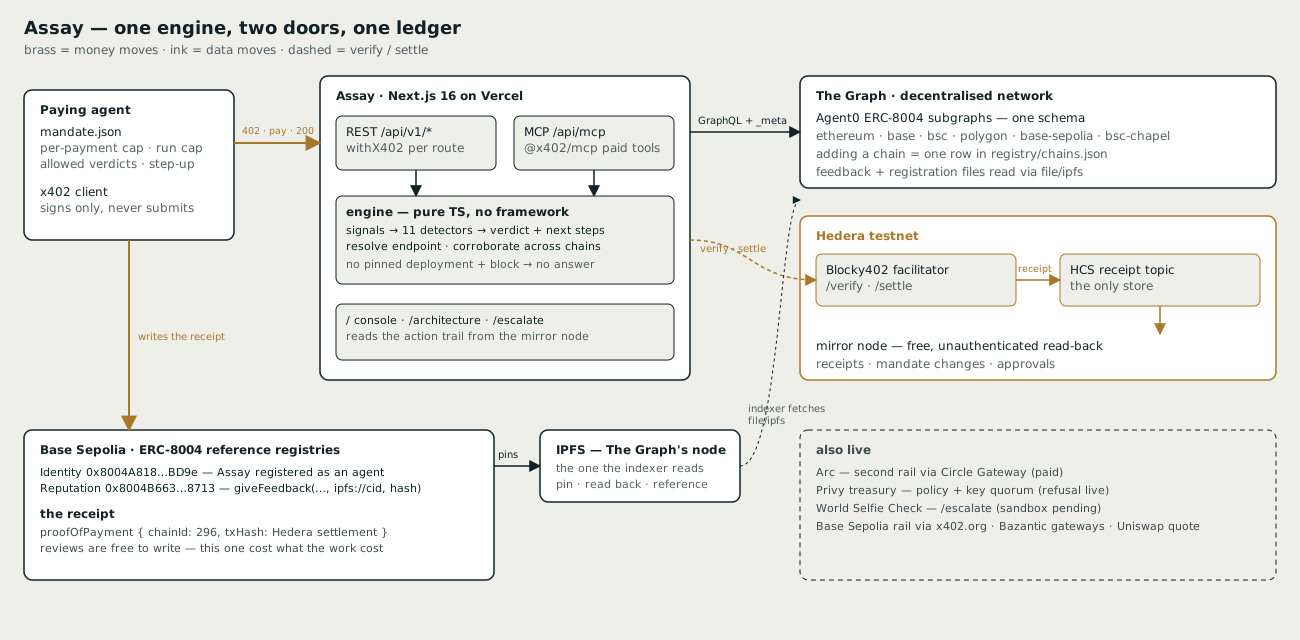
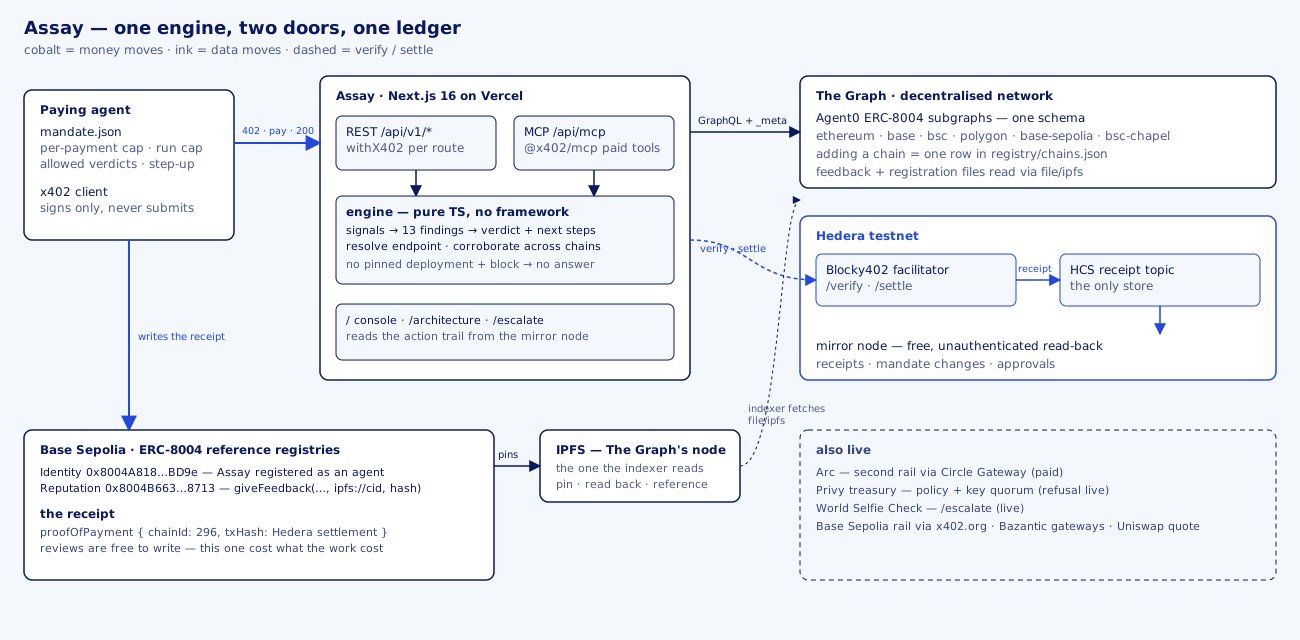
One engine, two doors, one ledger.
Cobalt is money moving; ink is data moving; dashed is verify and settle.
scroll the diagram sideways ↔
Read path
- An agent asks; the route answers
402with x402 requirements on three rails, priced by the work the route does. - The agent signs and retries. The facilitator verifies; the handler runs; settlement happens only on success.
- The engine reads the Agent0 subgraph with
_meta. No pinned deployment and block, no answer. - Named findings → a verdict, the evidence, and what would change it. Confidence only from payment-backed, independent reviews.
- A receipt lands on the HCS topic. The topic, read through the mirror node, is the whole memory. No database.
Write path — the receipt
After paying, the agent writes ERC-8004 feedback about Assay on Base Sepolia whose file carries proofOfPayment with the settlement. The file is pinned to The Graph's IPFS node because the indexer reads feedback only through file/ipfs. The next read of Assay shows a review that cost what the work cost.
Where Assay finds a farm, it appends a response to the fake reviews themselves — permissionless in ERC-8004 — so the finding sits in the registry beside the reviews it is about.
Prose and the Mermaid source: docs/ARCHITECTURE.md · file: /architecture.svg